
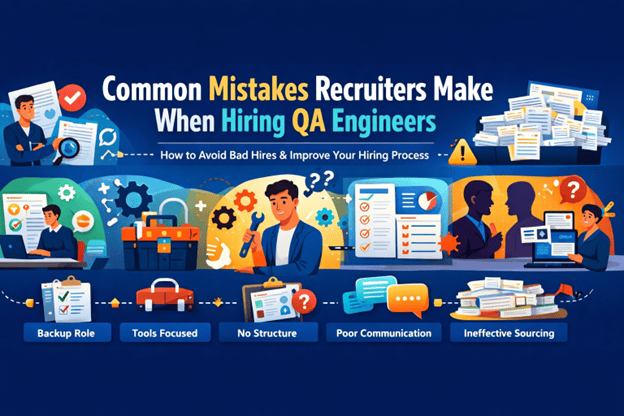
Common Mistakes Recruiters Make When Hiring QA Engineers
Hiring QA candidates for your organisation can be challenging, especially when you have to review a pile of resumes. A few profiles can impress you immediately. You find almost everything in the resumes you are looking for. You feel this hire may finally be the right one. You move fast, shortlist, schedule interviews, and close the role with a bit of relief.
But things start to change after a few days or weeks. The candidate is not performing as expected, or the team keeps going back and forth over missed bugs. You may be wondering: was it the candidate’s fault, or did something go wrong during the hiring process?
In most cases, the overlooked faults during the hiring process often lead to these issues. What are the mistakes? Let’s find out together!
Where QA Hiring Goes Wrong and How to Fix It
-
Treating QA as a Backup Role
If you believe QA engineers only validate finished code, this can heavily impact your hiring. You focus more on the tests they execute, but overlook their knowledge in understanding product qualities. As a result, you choose the wrong candidate.
In reality, strong QA engineers think critically, identify risks early, and collaborate across teams. By reducing interview rounds and using skill-based assessments, you can actually learn about the candidate’s capability. This ensures the hire adds value beyond basic testing.
-
Prioritising Tools Specialisation Over Problem-Solving Abilities
You examine the CV and notice that the candidate knows most tools. In the interview, you asked a few things about how they use these tools and other relevant questions. You forgot to ask anything related to problem-solving. While tools matter, they don’t define problem-solving ability.
Candidates who understand testing concepts deeply can adapt to new tools quickly, whereas tool-heavy profiles may struggle in unfamiliar scenarios. Skill-based evaluations, like those offered on modern assessment platforms, allow you to test real-world thinking instead of relying solely on keyword matches.
-
Having an Improper Structure for Hiring
This is one of the biggest mistakes that leads to bias and bad hires. When hiring processes lack structure, decisions can become inconsistent and influenced by unconscious bias. You choose a candidate based on the questions you never asked others.
Adopting structured, skill-based evaluations supports reducing hiring bias in tech. Consistent benchmarks ensure that decisions are based on capability rather than subjective impressions. It leads to more reliable hiring outcomes.
-
Underestimating Communication Skills
Another common mistake you should definitely avoid when hiring a new QA engineer. You often prioritise the technical ability of the candidate. And it is completely fine. But you should not underestimate their communication skills too.
They need to interact regularly with developers and product managers. Clear bug reporting and effective collaboration are a must for smooth workflows. A candidate who can explain test scenarios or document findings properly streamlines team operations.
-
Using Ineffective Sourcing Channels
Relying solely on general job boards often results in high application volume but low relevance. This creates additional screening effort without guaranteeing quality candidates.
Specialised sourcing combined with assessment-driven filtering creates a more efficient pipeline. A focused QA job platform with skill validation tools helps you connect with candidates who are both relevant and capable. It helps reduce time-to-hire while improving quality.
QA hiring does not fail because of a lack of effort; it often weakens due to small, repeated gaps in evaluation and decision-making.
What you can do is start using modern skill-assessment platforms to filter out candidates who are not strong in their skills and find candidates who are the best fit for your company.
Using modern solutions is not just for convenience; it protects your company from loss and bad hires. When you can successfully reduce bad hires, it helps you boost your overall productivity and quality of work.



Leave a Reply