
Why Enterprises Fail at Document Management? Here are the Common Reasons
Every day, your teams are losing time, deals, and trust, not because of strategy failures, but because of something far more mundane: they can’t find the right document at the right time. Document management sounds boring until it costs you a major contract, a compliance audit gone wrong, or three hours of someone’s morning searching through email threads.
Do you know the uncomfortable truth? Most enterprises fail at document management, not from lack of effort but from deeply rooted habits and blind spots. Here’s where it all goes sideways.
Document Management Failures Are Costing Enterprises Millions: Here’s What’s Going Wrong
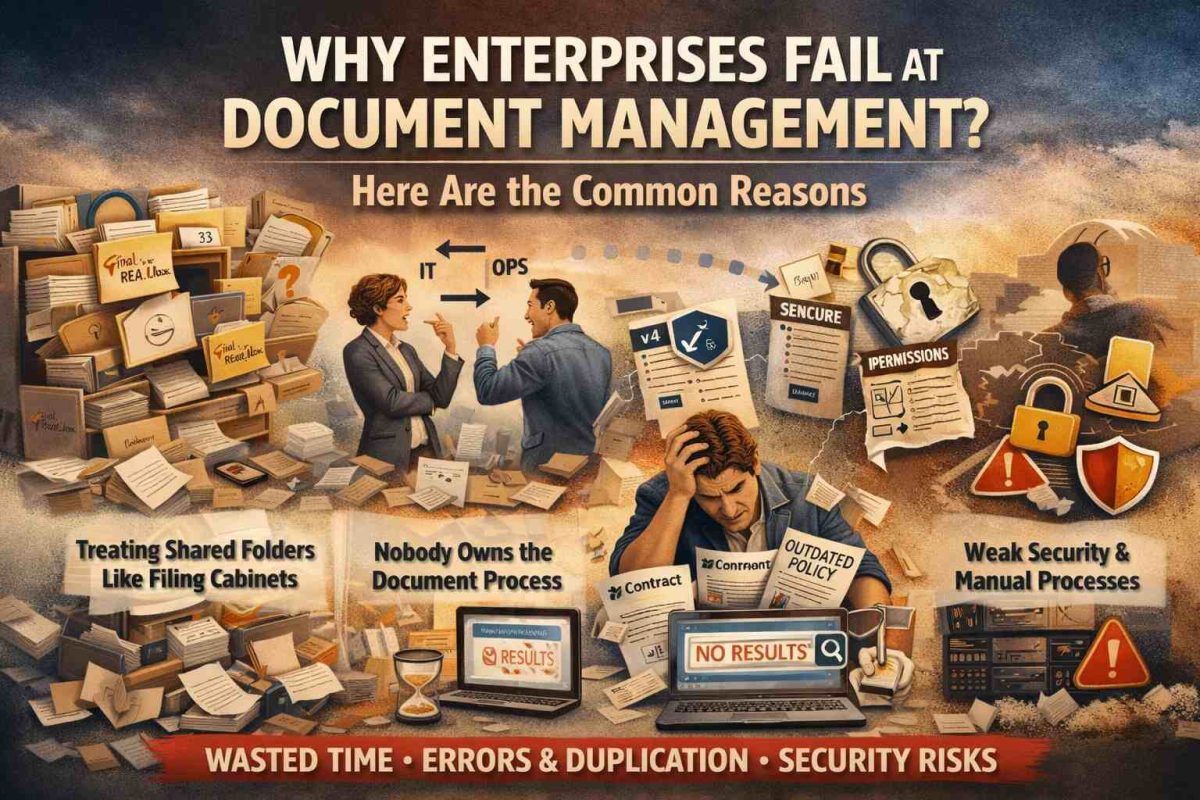
Treating Shared Folders Like Filing Cabinets
Shared drives weren’t for the scale of modern business. Yet most organizations still operate like it is 2005 by dumping files into nested folders with names like “Final_v3_REAL_this_time.docx.” When there is no consistent naming convention, no metadata tagging, and no access hierarchy, your digital workspace becomes a digital junkyard. People stop trusting the system and start keeping their own local copies, which only worsens everything.
Nobody Owns the Document Process
Document chaos thrives where accountability is absent. If no single department or individual is responsible for maintaining standards, like how documents are named, stored, versioned, and retired, entropy takes over fast. IT thinks it is a business problem. Operations thinks it is an IT problem. Meanwhile, nobody is solving it.
Zero Version Control Means Constant Errors
How many times has someone on your team submitted the wrong version of a proposal or worked off an outdated policy document? Without a proper Document Management System enforcing check-in/check-out controls, version history, and clear audit trails, you’re essentially gambling with accuracy every single day. And in regulated industries, that’s not just inefficient — it is a liability.
Broken Search Kills Productivity Silently
If your employees can’t find what they need in under a minute, they’ll either ask a colleague (interrupting them) or recreate the document from scratch (wasting hours). Most enterprises underestimate how much a broken search experience costs in lost productivity. When content isn’t indexed, tagged, or structured intelligently, your knowledge base becomes a black hole.
Ignoring Automation Keeps You Stuck in Manual Hell
Too many enterprises are still manually sorting, classifying, and routing documents — tasks that are slow, error-prone, and frankly, unnecessary in 2026. Organizations that have embraced AI document management are processing invoices, contracts, and compliance forms in a fraction of the time, with fewer errors and stronger audit readiness. Clinging to manual workflows isn’t being cautious — it’s falling behind.
Inconsistent Security Creates Hidden Vulnerabilities
Document-level security is often an afterthought — applied broadly or inconsistently. Over-permissioned access means sensitive contracts or HR files are visible to people who have no business seeing them. Under-permissioned access creates bottlenecks. Either way, you’re exposed to data breaches, compliance violations, or just operational friction.
The Fix Starts With Honest Assessment
Before you invest in any new tool or process, take a hard look at how documents actually flow through your organization today. Where do they get created? Where do they get stuck? Where do they disappear? That audit will tell you more than any vendor demo.
Document management isn’t glamorous, but getting it right powers everything else in your business.




Leave a Reply